

Early Neurological Stimulation (ENS) — How We Give Every Puppy a Head Start
INTRODUCTION
At Bernedoodles and Co, raising a healthy puppy does not begin at eight weeks. It begins on day three of life.
Every litter born in our Northern California homes receives Early Neurological Stimulation — a science-backed development protocol that we administer to every puppy, on every litter, as standard. Not as an add-on. Not as a premium option. Every single puppy.
This page explains what ENS is, why it matters, and exactly how we apply it — so that when your puppy comes home, you understand the foundation they are already standing on.
WHAT IS EARLY NEUROLOGICAL STIMULATION (ENS)?
Early Neurological Stimulation, also known as the Bio Sensor Programme or the Super Dog Programme, was originally developed by Dr. Carmen Battaglia for the United States military. The U.S. Army used it to produce dogs with superior working ability — dogs who were calmer under pressure, faster to learn, and more resilient in stressful environments.
The protocol is based on a simple principle: the neurological system of a newborn puppy is still developing, and gentle, specific stimulation during this window produces measurable improvements that last for life. Stimulation outside this critical period has no effect. The window is narrow — day 3 to day 16 — and cannot be repeated.
Research published through the U.S. military’s canine programme found that puppies who received ENS showed five specific advantages over puppies who did not:
- Improved cardiovascular performance — stronger heart function
- Stronger adrenal glands — better hormonal regulation under stress
- Greater tolerance to stress — calmer responses to unfamiliar situations
- Greater resistance to disease — more robust immune response
- Stronger and more stable neurological development overall
These are not minor improvements. They are lifelong advantages that shape how your dog handles vet visits, thunderstorms, new environments, children, and everything else life brings.

THE FIVE ENS EXERCISES
Each exercise is performed once per day, for 3 to 5 seconds only. More is not better — the protocol is precise. Each position places a mild, specific stress on the puppy’s developing neurological system in a way that activates and strengthens it.
Exercise 1 — Tactile Stimulation
The puppy is held in one hand and gently stimulated between the toes with a cotton bud for 3 to 5 seconds. This activates the tactile nervous system.
Exercise 2 — Head Held Erect
The puppy is held with both hands, perpendicular to the ground with the head pointing up, for 3 to 5 seconds. This stimulates the vestibular system.
Exercise 3 — Head Pointed Down
The puppy is held with both hands, perpendicular to the ground with the head pointing down, for 3 to 5 seconds. This provides a different vestibular stimulus from Exercise 2.
Exercise 4 — Supine Position
The puppy is placed on its back in the palm of one hand, gently held, for 3 to 5 seconds. This creates a mild positional stress different from any position the puppy naturally assumes.
Exercise 5 — Thermal Stimulation
The puppy is placed on a cool, damp towel — separate from its mother and littermates — for 3 to 5 seconds. This provides a mild thermal stimulus that activates the nervous system differently from the warmth of the litter.
All five exercises are completed each day from day 3 through day 16. After day 16 the critical window closes and the protocol is complete.
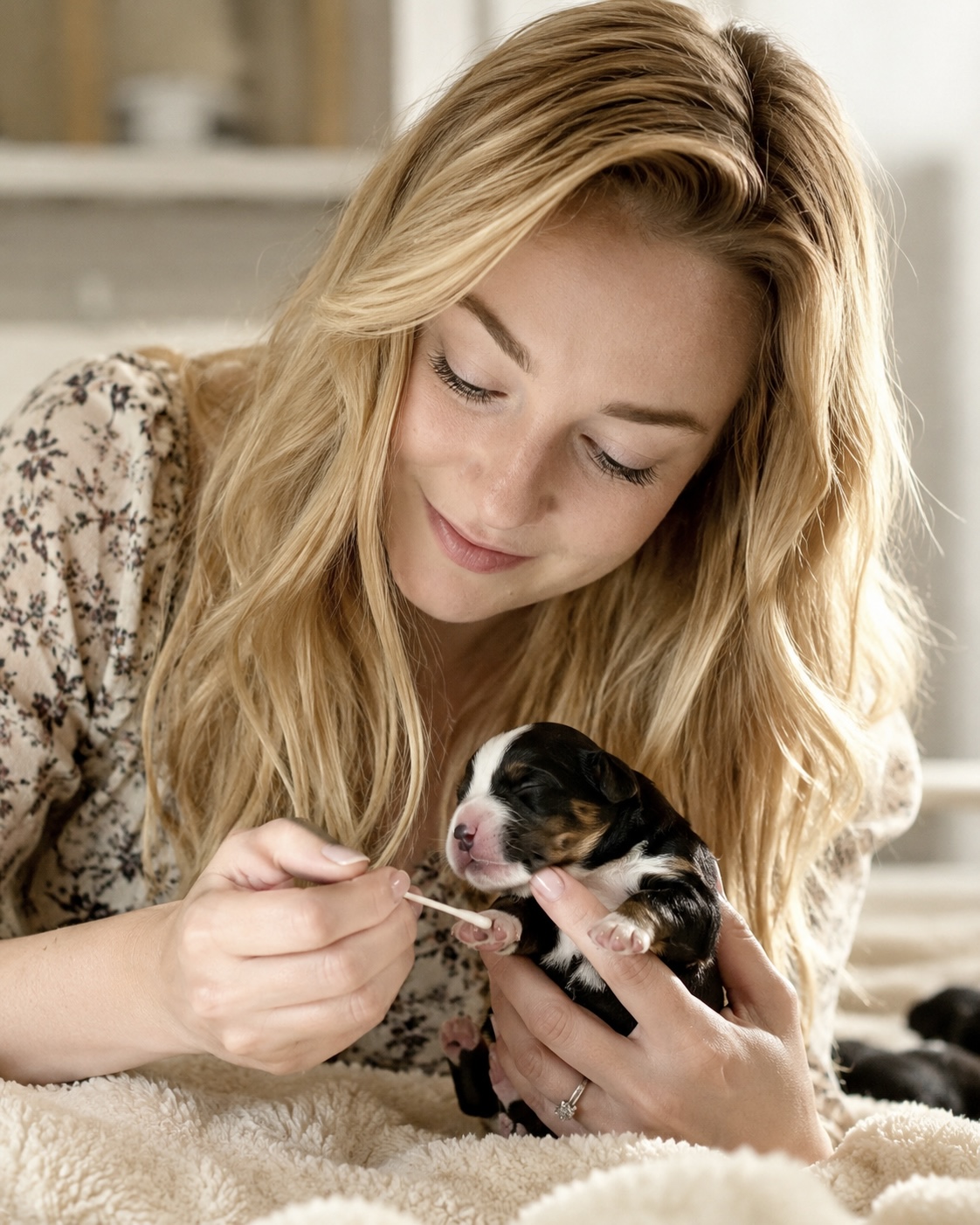
MEET DASHA — OUR PUPPY TRAINER
At Bernedoodles and Co, ENS is not something we read about and try to apply ourselves between other tasks. We have Dasha — a dedicated Puppy Trainer who works with every litter as part of our standard programme.
Dasha administers all five ENS exercises daily from day 3 to day 16 on every litter. She tracks each puppy individually, ensures the protocol is applied correctly and consistently, and monitors each puppy’s response throughout the process.
After the ENS window closes, Dasha continues working with the litter through our structured socialisation programme — introducing puppies to household sounds, different flooring surfaces, varying temperatures, handling by multiple people, and the early experiences that build a confident, adaptable dog.
Having a dedicated trainer — rather than folding this work into an already full schedule — means no litter is missed, no day is skipped, and no puppy is shortchanged.
WHAT HAPPENS AFTER ENS — STRUCTURED SOCIALISATION
From week three onwards, every Bernedoodles and Co puppy receives daily structured socialisation designed to build confidence and reduce reactivity. This includes:
- Exposure to household sounds — vacuum cleaners, televisions, doorbells, children playing
- Varied flooring surfaces — carpet, hardwood, tile, grass, gravel
- Handling by multiple people — adults, children, visitors to our homes
- Introduction to crates — positive early associations before your puppy comes home
- Gentle exposure to collars and leashes
- Car rides — short trips to reduce travel anxiety
- Meeting other dogs in a controlled, safe environment
By the time your puppy is ready to come home at eight weeks, they have already encountered most of the experiences that first-time puppy owners worry about. They are not blank slates — they are prepared.
THE WELCOME HOME TRAINING FOUNDATION (OPTIONAL)
For families who want to give their puppy the smoothest possible transition, we offer the Welcome Home Training Foundation — an optional programme designed by Dasha.
The programme covers:
- Potty training basics and a consistent schedule
- Crate confidence — building a positive relationship with the crate from day one
- Leash introduction
- Sit, stay, and come — foundational commands started before pickup
- Settling and calm behaviour around the home
The Welcome Home Training Foundation is available as an additional enrolment. Contact Anna for full details, timing, and pricing.
EVERY PUPPY. EVERY LITTER. NO EXCEPTIONS.
We want to be clear about something: ENS is not a selling point we add to certain puppies or certain litters. It is what we do with every puppy, every time, because we believe every puppy deserves the best possible start.
When you bring home a Bernedoodles and Co puppy, you are not bringing home a dog that was simply fed and kept warm for eight weeks. You are bringing home a dog whose neurological system was actively developed from day three of life by a trained professional — and whose socialisation was deliberate, structured, and consistent from that moment forward.
That is the standard we hold ourselves to. And it is one of the reasons our families tell us their Bernedoodles are calmer, more confident, and easier to train than dogs they have owned before.